Understanding Interoception: The Sense We Rarely Talk About
Updated: Jul 30
When people think about our senses, they usually think of the familiar five: sight, hearing, touch, taste and smell. Some people may also have heard of the vestibular system (balance) or proprioception (our awareness of where our body is in space).
However, there is another incredibly important sense that often goes unnoticed: interoception.
Interoception is your brain's ability to notice, interpret and respond to signals coming from inside your body. It helps you understand how your body is feeling at any given moment and lets you know when you need to take action.
For many autistic people, people with ADHD, or those with sensory processing differences, interoception can work differently. This can make everyday life much more challenging than people realise.
What is Interoception?
Think of interoception as your body's internal communication system.
Your brain is constantly receiving messages from your heart, lungs, stomach, muscles and other organs. These messages help you recognise things such as:
Hunger
Thirst
Feeling full
Needing the toilet
Feeling too hot or too cold
Pain or illness
Tiredness
A racing heart
Butterflies in your stomach
Feeling calm, anxious or excited
Most of us rely on these signals without even thinking about them.
When interoception works differently, those messages may be delayed, difficult to recognise or overwhelming.
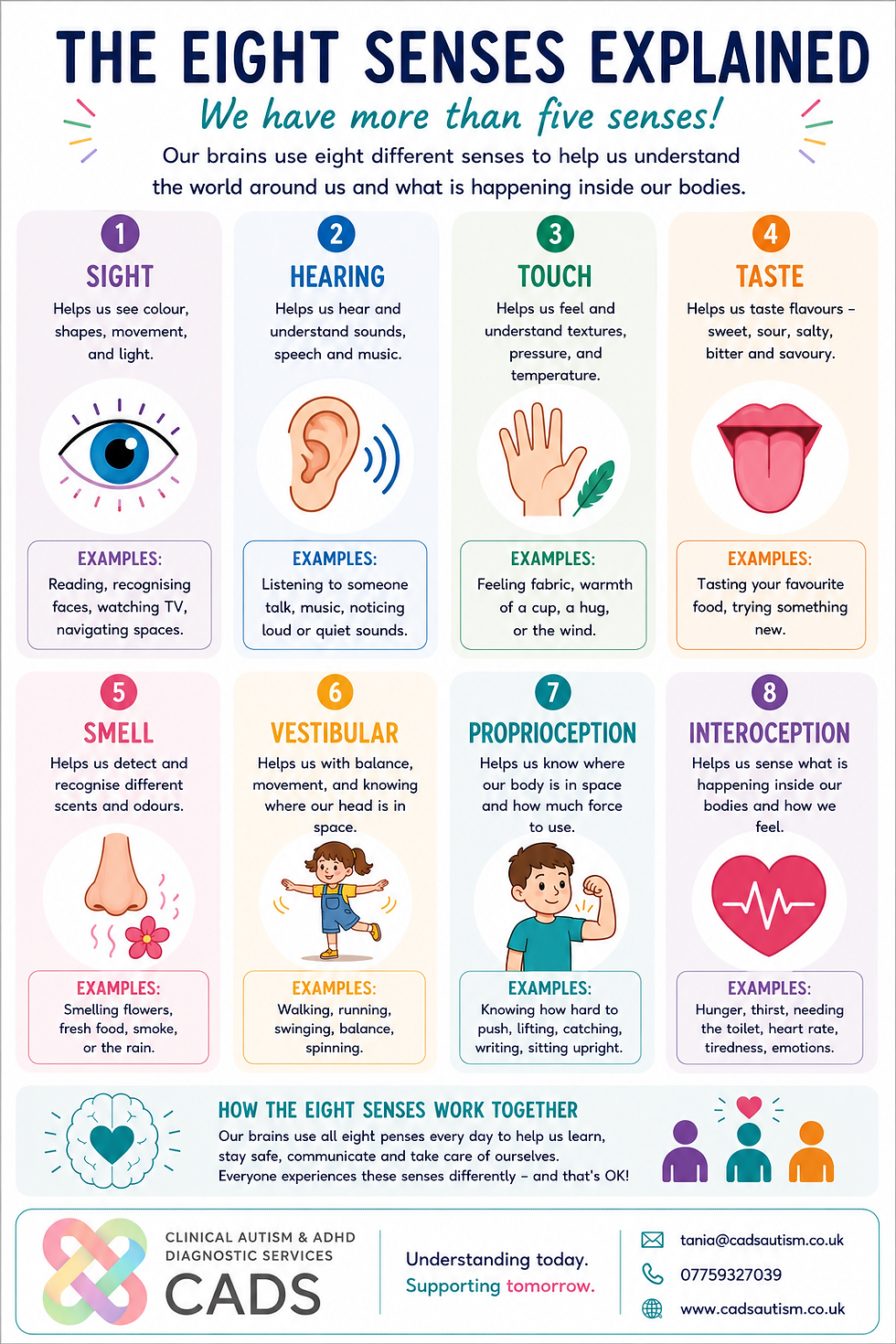
The diagram below shows all eight senses and the important role each one plays in helping us navigate everyday life. While sight, hearing and touch are familiar to most of us, the three "hidden" senses 'vestibular, proprioception and interoception' are just as important, particularly when we think about autism, ADHD and sensory processing differences.
What Might Interoceptive Differences Look Like?
Everyone experiences interoception differently, but some common examples include:
Missing body signals
Some people don't notice internal signals until they become very strong.
They might:
Forget to eat because they don't feel hungry.
Become dehydrated because they rarely feel thirsty.
Wait until the last minute before using the toilet.
Suddenly feel exhausted after pushing through the day.
Not notice they are becoming unwell until symptoms are severe.
Strong or overwhelming body signals
Others experience internal sensations very intensely.
They may:
Feel every stomach movement.
Become overwhelmed by a racing heart.
Experience intense discomfort with minor illness.
Feel pain more strongly than others.
Become highly aware of changes in breathing or temperature.
Neither experience is "right" or "wrong", they simply reflect differences in how the brain processes internal information.
Why Does This Matter?
Interoception influences almost every part of daily life.
Eating and drinking
Someone may skip meals because they don't recognise hunger until they suddenly feel shaky or irritable. Others may struggle to recognise when they are full.
Sleep
Many people don't notice tiredness building gradually. Instead, they continue until they suddenly "hit a wall."
This is particularly common in ADHD, where interest and stimulation can override internal cues to rest.
Toileting
Children and adults may not notice they need the toilet until it becomes urgent, sometimes leading to accidents or constipation.
Recognising illness
Some people may appear to "carry on regardless" because they don't realise they are becoming ill. Others may experience physical symptoms very intensely, making illness feel overwhelming.
Interoception and Emotions
One of the most important jobs of interoception is helping us recognise emotions.
Our emotions are closely linked to physical sensations.
For example:
Anxiety may feel like a racing heart, butterflies or tightness in the chest.
Anger might involve tense muscles and feeling hot.
Excitement can also involve a fast heartbeat.
Sadness may feel heavy or draining.
If someone struggles to recognise these physical changes, identifying emotions can become much harder.
Instead of thinking "I'm anxious," they may simply know that something feels wrong.
This is one reason some autistic individuals experience alexithymia, which describes difficulty identifying and describing emotions. Rather than struggling with emotions themselves, they may struggle to recognise the body's signals that help define them.
Interoception in Autism and ADHD
Interoceptive differences are common in both autism and ADHD, although they may present differently.
In autism
Many autistic people describe either missing internal signals or experiencing them much more intensely.
These differences may contribute to:
Sensory overload
Difficulties recognising emotions
Eating and drinking challenges
Sleep difficulties
Increased anxiety
Difficulties recognising pain or illness
In ADHD
People with ADHD often know what they should do but don't notice the body signals that prompt action.
For example, they may become so absorbed in an activity that they miss signs they are hungry, thirsty, tired or need the toilet.
Interoception can also contribute to emotional regulation difficulties, as recognising the early signs of frustration or overwhelm allows us to respond before emotions become too intense.
Interoception and Everyday Overwhelm
When your brain isn't receiving clear information from your body, everyday tasks become much harder.
Imagine trying to concentrate when you're dehydrated but don't realise it.
Or trying to stay calm when your heart is racing but you can't identify why.
Many people assume these are problems with motivation or organisation, when in reality the body and brain are struggling to communicate effectively.
Understanding interoception helps us move away from asking, "Why won't they?" and instead ask, "What signals might they be missing?"
Can Interoception Improve?
The good news is that interoception can often be supported.
The goal isn't to "fix" someone but to help them become more aware of their body's signals over time.
Helpful strategies include:
Regular body check-ins throughout the day.
Using visual reminders to eat, drink or use the toilet.
Developing predictable routines around meals and hydration.
Exploring where different emotions are felt in the body.
Rating energy levels throughout the day.
Practising mindfulness or gentle movement to notice body sensations.
Helping children build vocabulary for physical sensations as well as emotions.
Progress is often gradual, but even small increases in body awareness can make everyday life feel more manageable.
A Different Way of Understanding Behaviour
Interoception reminds us that behaviour is often communication.
A child who suddenly has a meltdown may actually be exhausted, hungry or overwhelmed without recognising it.
An adult who forgets to eat all day isn't being careless, they may genuinely not notice the signals their body is sending.
Understanding interoception allows us to respond with curiosity rather than judgement.
When we understand interoception, we move away from asking, "Why won't they?" and instead begin asking, "What might their body be trying to tell them?" That small shift in perspective can make a huge difference to the support we provide.
At CADS, we believe that understanding how a person experiences the world, both around them and within their own body, is key to providing meaningful support. Whether you're exploring autism, ADHD, sensory processing or simply trying to make sense of everyday challenges, learning about interoception can help replace frustration with understanding, compassion and practical strategies that make daily life a little easier.


Comments